
Religion is a major point of identity for many people and can be an important form of connection and community, including for those who emigrate from other countries, to the many diverse populations that currently reside here, and the Indigenous Peoples living in what we now call Canada. Canada has a long history of religion, it is even embedded in our National Anthem, from the colonization by the French in the late 1500s (which introduced Roman Catholicism), to the English who brought Anglicanism in the 1600s. As North America continued to be settled, people of different faiths including various Protestant sects, Judaism, Islam, Buddhism, Sikh individuals, and many more now call Canada home.
This blog post will look at the presence of religion in the rural communities of Alberta in the early 1900s as well as the religious connections that are evident in the beginnings of the United Farmers of Alberta (UFA). Religion can be seen in several areas of the UFA, including U.F.A. Sunday – a significant community event, the United Farm Women of Alberta, and early UFA leaders.
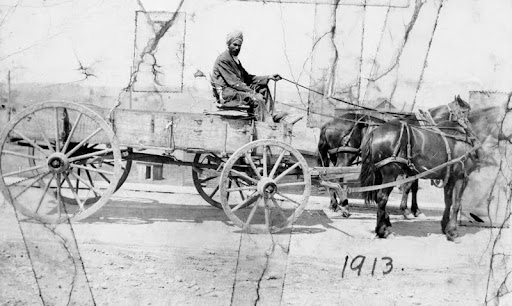
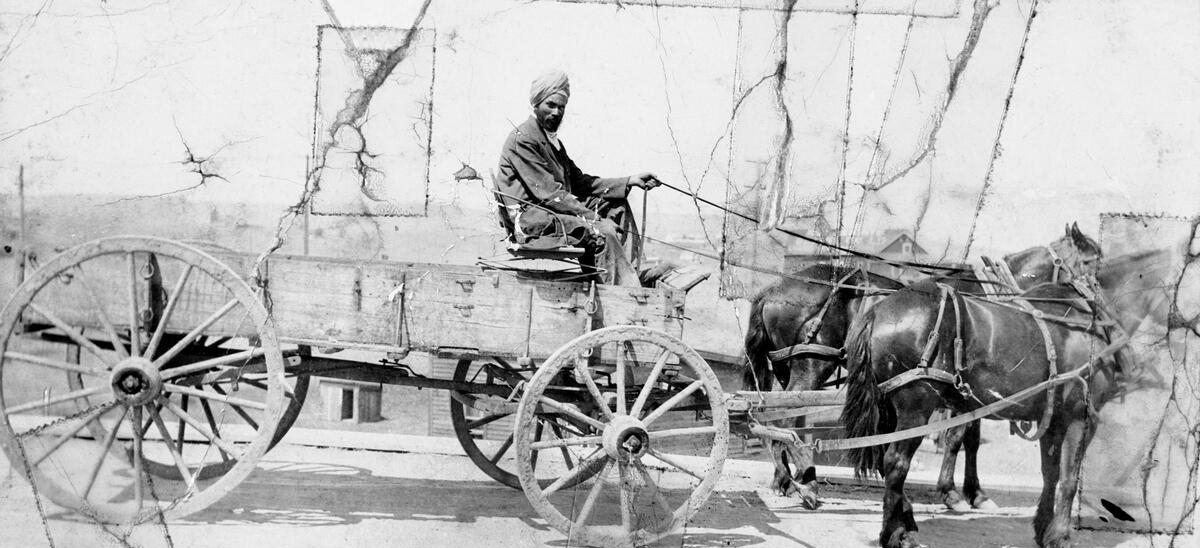
“Harnan Singh Hari, driving wagon, De Winton area, Alberta.”, 1913, (CU1102785) by Unknown. Courtesy of Glenbow Library and Archives Collection, Libraries and Cultural Resources Digital Collections, University of Calgary.
UFA Sunday
For farmers in particular, religion was an important aspect of their daily life on the prairies, and aided in gathering and motivating the people of rural communities. During the early 1900s, urban centres in Western Canada were still sparse and people were spread out across the prairies. As settler communities sprung up on the prairies, gathering spaces were created for children to attend school, and groups to hold meetings, organize weddings and funerals, and of course to hold Sunday Services. Religion became a common unifier for settlers, as early life on the prairies was often harsh and challenging. Religion, and the community that came with having a shared faith, helped bond people together and aided in maintaining connections to their homeland.
Fostering a sense of community became necessary for survival in the early 1900s in Alberta. Farming conditions were coming more to the forefront and issues such as drought, crop disease, cold winters, and the hardship of rural living were becoming more apparent. The UFA quickly recognized this upon their formation in 1909, and found that by combining farming resources as a co-operative helped to secure better deals on supplies and better prices for agricultural commodities. Farmers realized that by banding together, they had a better chance to influence policy and pressure the government to take notice of issues that were important to them.
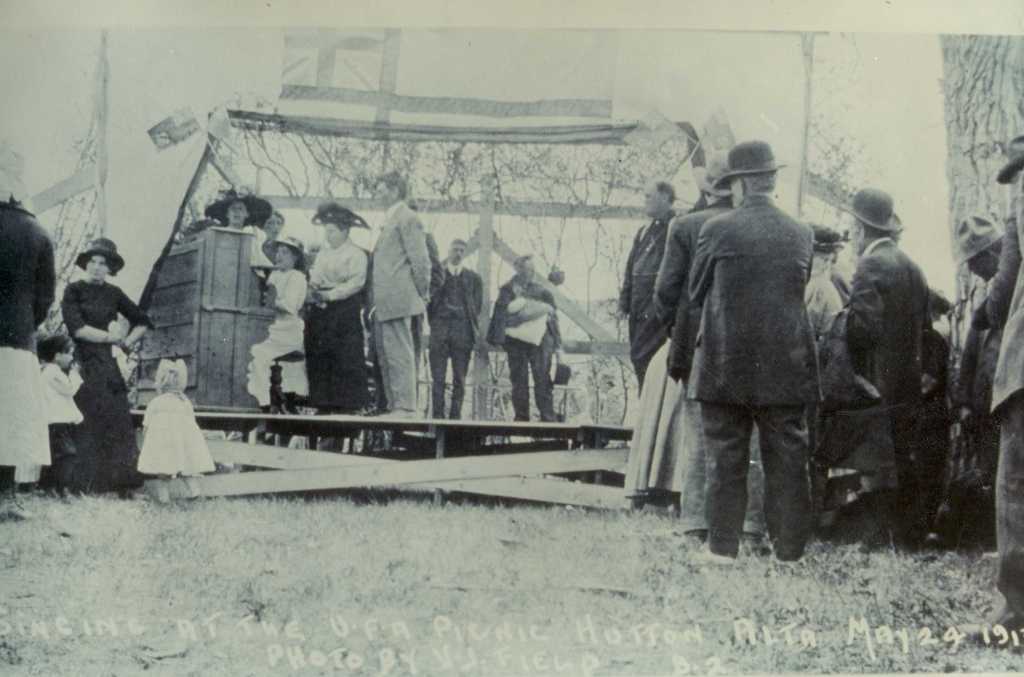
Singing at the UFA Picnic, 1913 (United Farmers Historical Society, UF 2004.0037.25).
While the UFA as an organization helped to unite farmers and influence change regarding farming issues, there was another impact as well, and farmers began to organize for social reasons. One of the earliest known community events put on by UFA Locals was U.F.A. Sunday, a day dedicated to church services, picnic lunches, sporting events, evening dances, sing-alongs, and more. This event was organized to embrace the common foundation that many farmers held – community and religion. In a 1915 article from the The Grain Growers’ Guide, UFA President James Speakman stated:
“We are accused sometimes of confining ourselves too much to the material side of life. It is well that we should be reminded somethings of the really Christian basis on which the U.F.A. rests. Many of us agree with the old saying, ‘Unless the Lord build a house, vain is the work of the builders,’ and such a U.F.A. Sunday gathering together of men and women of many churcher and of no church might help to foster a spirit of union which the numerous sects greatly need.”
James Speakman in The Grain Growers’ Guide, June 9th 1915 (United Farmers Historical Society, 74-11e).
According to Speakman, U.F.A. Sunday was more than a religious celebration, but a way to unite the people of the area from all religious creeds, together as a community. In addition, Speakman clearly states that, at the time the UFA was largely based on Christian morals. This is echoed by Reverend Mr. Phelps of Strathmore who was quoted in an article titled “Christianity and the Basic Industry” from the Grain Growers’ Guide:
“Evidently this association believes with the church that the practical application of the Christian principles would bring reforms and conditions for which both are earnestly striving. The U.F.A. is very practically concerned with religion as a power which sets itself against wrong, seeking to eradicate evil through establishing justice and equity in human relationships.”
Reverend Mr. Phelps of Strathmore, “Christianity and the Basic Industry” in the Grain Growers’ Guide, Oct 5th 1921 (United Farmers Historical Society, 74-11e).
U.F.A. Sunday became an annual occurrence for many UFA Locals from all around the province. While the day was organized around religious services and speeches, U.F.A. Sunday consisted of a variety of activities to suit all, including athletics, music, dancing and fun. The event grew in popularity and eventually transitioned into the Farmer’s Day that we still celebrate today. While the religious aspect of Farmer’s Day has since disappeared, its origins began with U.F.A. Sunday, a day founded on Christian principles to be celebrated by the community as a whole.
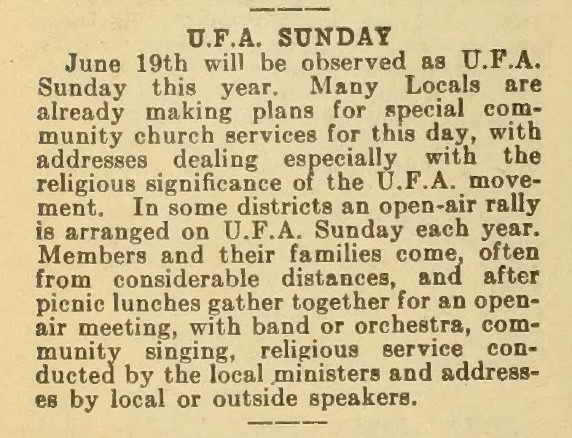
Excerpt on U.F.A. Sunday noting the “religious significance” of UFA (United Farmers Historical Society, The U.F.A., May 16th 1927). 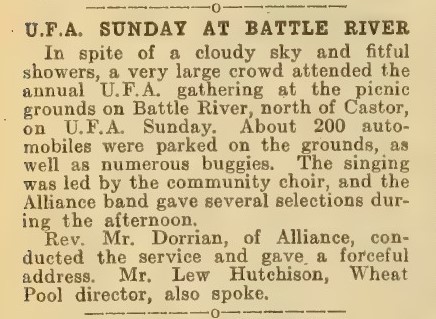
Excerpt on U.F.A. Sunday noting the appearances of a choir and Reverend Dorrian (United Farmers Historical Society, The U.F.A., July 4th 1927). 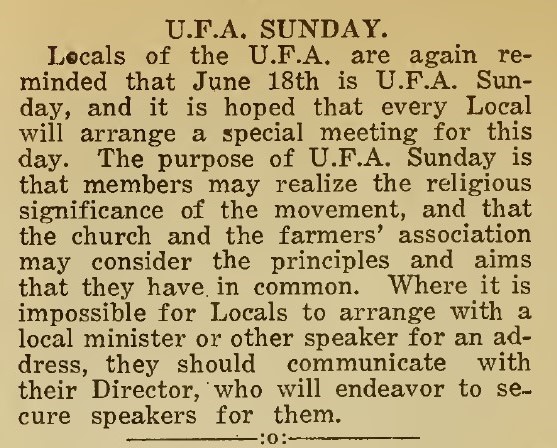
Excerpt on U.F.A. Sunday encouraging Locals to arrange for a minister to attend the event (United Farmers Historical Society, The U.F.A., June 1st 1922).
United Farm Women of Alberta
“Supper, usually bread and lard, saskatoons in milk, lots of tea, and then singing for a time, a few verses from the Bible, and then to bed with the chickens. That was our life”
The Pioneer Years, p. 180-181.
In the early 1900s, Alberta Women’s Institutes, the Woman’s Christian Temperance Union, and other organizations for women were becoming more prevalent, providing options for women to gather and connect with each other. Farm women in particular had unique issues and concerns specific to their rural location and the responsibilities they had to the homestead. The formation of the UFA had seen a new sense of community arise out of shared experiences and common grievances, and farm women were looking to build community among themselves that could address the problems that they faced, such as farm safety, access to medical care, and proper rural education for their children. What women often found was that they benefited from having a community to share with. These small social groups soon led to more organized groups including the United Farm Women of Alberta (UFWA) which was founded in 1916 as a separate organization from UFA.
Religion was a way of life for many European settlers who brought their Christian faith with them to Canada, and the women of the UFWA were no exception. The organization was primarily founded by Anglo-Protestants and other settlers from Western Europe. Their overt religiousness was well known, and included publishing articles in The U.F.A. One article titled “Religion Not Safety, but Service” was addressed to all farm women and stated that “to some it is necessary to subscribe to certain beliefs, and those who cannot honestly do so are beyond the pale” (The U.F.A. 1927, vol. 6, no. 2, p.16). This indicates that the right religion was almost viewed as permission for membership in the organization. Other articles from The U.F.A. include religious book reviews and regularly highlighting Christian celebrations including Easter and Christmas.
The UFWA primarily focused on increasing access and quality of public services like hospitals and schools, but as time progressed, women’s rights and suffrage became a large part of their purpose. These activities did not result in a more secular society, as Bradford Rennie points out, but the UFWA “filled the gap” of disorganized religion in the province “by becoming a quasi-religious institution.” UFWA Secretary Leona Barritt stated that it was commonly seen as the role of women to be “responsible for children’s moral development”, therefore many members spent their efforts doing “the social work that the church has been unable to do” (in Rennie, p. 83). In this example, the UFWA took the initiative that organizations like the Church and even the UFA, were not. Therefore, this ‘quasi-religious’ community based on common morals and values allowed a space for these women to lead in remedying the shortcomings they saw in society by taking up zeal for public services in a religious-like manner.
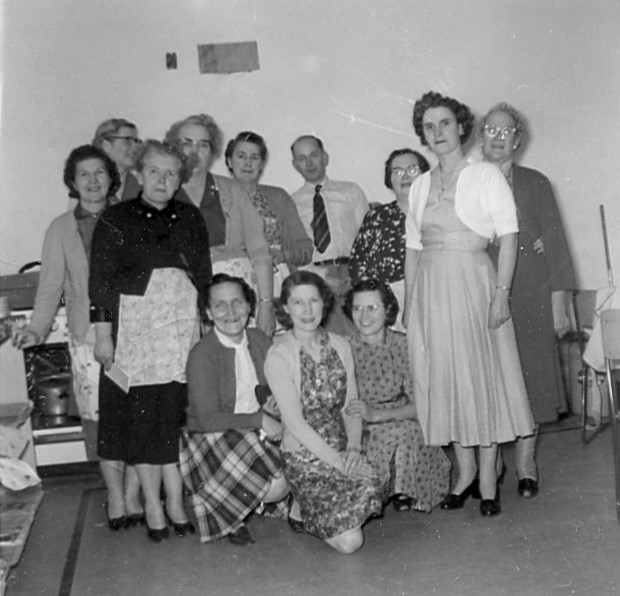
In addition, the minutes of UFWA meetings show issues that were pressing to the organization and this included motions that were put forward from a religious perspective. A report from the UFWA Education Committee presented at the 1924 Annual Convention recommended compulsory bible reading in schools. While the resolution was amended to say it will urge the government to ensure that bible stories and a history of the bible be made available in public school libraries, the initial idea that Christian learning should be mandatory for children is apparent. Other discussions included religion being taught in public schools and religious freedom over secularism on university campuses. The UFWA created a community based on shared values and concerns for women to make their voices heard, and they used meetings, conventions, events, and written communication to spread their ideals for the organization. While religion was as strong unifier for these women, it is also likely that the organization excluded farm women who laid outside of these expectations, from other religions or even countries not considered ‘dominant’ at the time.
UFA Leaders
One of the UFA’s most prolific leaders was Henry Wise Wood, who was president of UFA from 1916 to 1931. Wood is known for being the most dynamic farm and social leader of his day, and has even been referred to as the “Agrarian Moses”. Clark Banack, author of “Evangelical Christianity and Political Thought in Alberta” argues that Henry Wise Wood’s religious provocations were a driving force in how he influenced the UFA, particularly during their time in government, and that he subsequently shaped and molded the ebb and flow of Alberta’s politics. Banack states that Wood’s perspective on the role of rural people as Christians was that “reborn citizens could build the Kingdom of God on earth by way of intense ground-level participation and co-operation” (Banack, 72).
Wood was a successful farmer in Missouri before moving to the Carstairs area in 1905. He aligned himself with the Social Gospel religious movement which is a “social religion meant to address the ills of an industrializing society such as poverty and inequality” (Banack, 76). Wood believed that “co-operation between citizens was the key activity demanded of humankind by God in its struggle to establish His Kingdom on earth” (Banack, 82). Wood’s religious convictions were intertwined with his views on economics, ethics and co-operation. He had a large influence in the farming community and his religiosity solidified the concepts many rural folk already had established such as helping each other for the betterment of the community. Wood remained UFA President for 15 years, during a time when farming co-operatives and communities were growing and people looked to their farm leaders for guidance. Wood’s spirituality shaped his own perspectives and values and he became very respected for the wisdom that he brought to the farmers movement.
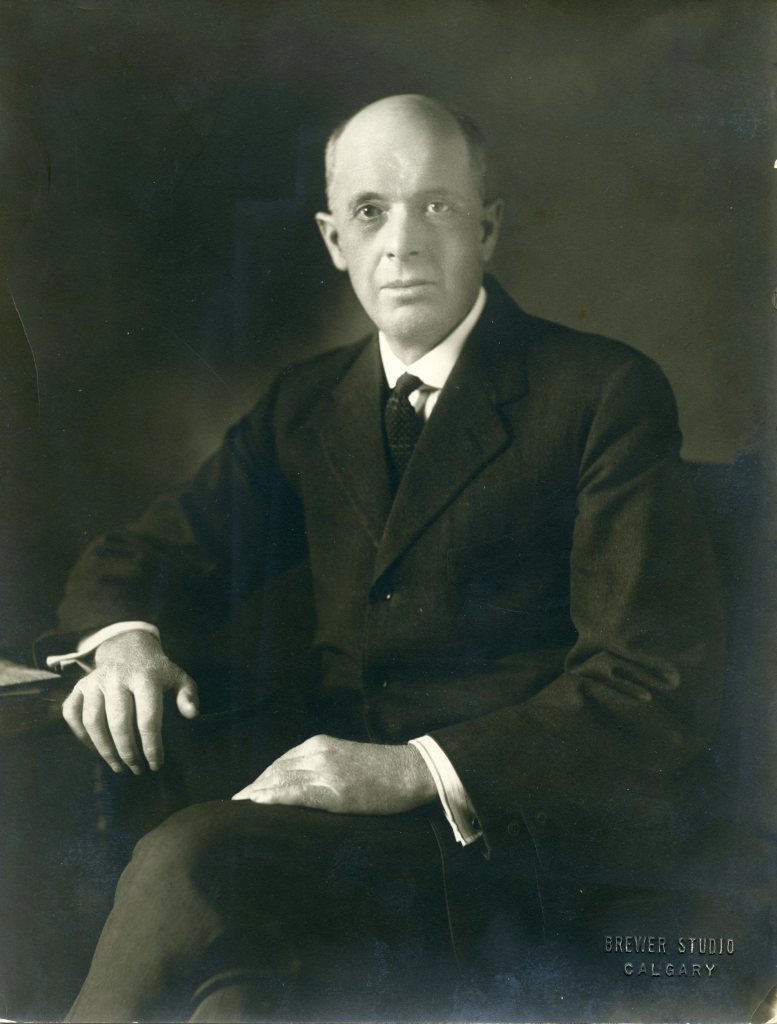
Another UFA leader with religious ties was UFA Director and President of the Provincial Political Association, A. Lunan, who wrote an editorial titled “On a Recent Sunday” in the August 1928 edition of The U.F.A. publication. He opens by recalling a recent Sunday Sermon about responsibility in which the minister spoke about the journey of entering a new field, first filled ‘with great hope and enthusiasm’ but as the journey continues and the results are not obvious, one ‘becomes down-hearted and discouraged’ feeling they may have missed their calling.
The minister continues but with a tone of hope, preaching that in the circumstance of new beginnings he takes the challenge and works to the best of his abilities and once he has “put forth every effort to fulfill the obligations of that responsibility, [he has] finished [his] work.” Lunan describes in the article how he related to this sentiment, recalling how “many a time have I suffered the anguish of mind, referred to above, over the meagre response to our message of hope,” but how he now feels at peace with the realization that his job is to spread this message of hope and that the responsibility lies with “the rank and file of farmers and farm women throughout the constituency” (The U.F.A. 1928, vol. 7, no. 20, p.7).
This message from Lunan was likely an encouraging one for members to persevere despite the results not being what was expected. By using the example of a minister’s sermon, Lunan not only justifies his message to his fellow members since a religious leader holds respect within a community, but also relates to them through religiously coded messages of hope and internal peace. By stressing the importance of responsibility, a concept many farmers are familiar with, Lunan further establishes the sense of general community with members of the UFA. Also significant to note is that religious articles such as this appeared in The U.F.A. to be distributed to their members which further implies not only the importance of religious tenets but how normalized and visible these themes were to the organization overall.
Today, UFA is not considered a religious organization, but UFA’s early origins are intrinsically linked to religion. This can be seen in the work that was carried out by the United Farm Women of Alberta, in UFA leaders who linked religion with farm co-operation, and UFA Sunday which was a significant celebration for farming communities. Early members of UFA Co-operative ingrained their Christian values of religion into the organization. This is not surprising, as the importance of religion to early agrarian settlers in Alberta is one of the many social aspects that has embedded itself into Alberta’s culture and society. This importance has itself manifested into a co-operative organization with the goal of making life easier and more fulfilled within farming communities still budding in the early 1900s.
Written by Autumn Waddington, Archives Assistant
Bibliography
Banack, Clark. “Evangelical Christianity and Political Thought in Alberta.” Journal of Canadian Studies 48, no. 2 (2014): 70-99.
Bell, Daniel. “The Protestant Ethic.” World Policy Journal 13, no. 3 (Fall, 1996): 35-39.
Broadfoot, Barry. The Pioneer Years 1895-1914: Memories of Settlers Who Opened the West. Ontario: PaperJacks Limited, 1976.
Rennie, Bradford James. The Rise of Agrarian Democracy: The United Farmers and Farm Women of Alberta, 1909-1921. Toronto: University of Toronto Press, 2000.
The U.F.A (1928, Aug. 15). “On a Recent Sunday” Vol. 7, no. 20, p. 7. Retrieved from https://archives.ufa.com/permalink/theufav7n20ufoa-7.
The U.F.A (1927, Jan. 15). “Religion Not Safety, but Service” Vol. 6, no. 2, p. 16. Retrieved from https://archives.ufa.com/permalink/theufav6n2ufoa-16.
“UFA Sundays (1920-1937)” Fonds 1, Series 8, File 10, 74-11e. In custody of the United Farmers Historical Society. Retrieved from https://archives.ufa.com/permalink/descriptions8518.
U.F.W.A. Executive, Board and Convention Minutes, 1915-1925, p. 190. Retrieved from https://archives.ufa.com/permalink/theufwa2116ufoa-190
Further Reading
Campbell, Marie J. ed. Still God’s Country: The Early History of Byemoor and Area, Alberta: Byemoor History Committee, 1975.
Fernández, Eva. “Trust, Religion, and Cooperation in Western Agriculture, 1880-1930.” Economic History Review 67, no. 3 (2014): 678-698.
Langford, Nanci. “United Farm Women of Alberta.” The Canadian Encyclopedia. Historica Canada. Article published October 10, 2006; Last Edited January 07, 2022.
Macpherson, Ian. “Henry Wise Wood.” The Canadian Encyclopedia. Historica Canada. Article published February 14, 2008; Last Edited December 16, 2013.
Priestley, Norman F. and Edward B. Swindlehurst. Furrows, Faith and Fellowship: The History of the Farm Movement in Alberta 1905 – 1966. Edmonton, Alberta: Co-op Press Limited, 1967.


Very interesting read! Religion was clearly prevalent in UFA
LikeLike
Thanks for your comment, so glad you enjoyed the read!
LikeLike