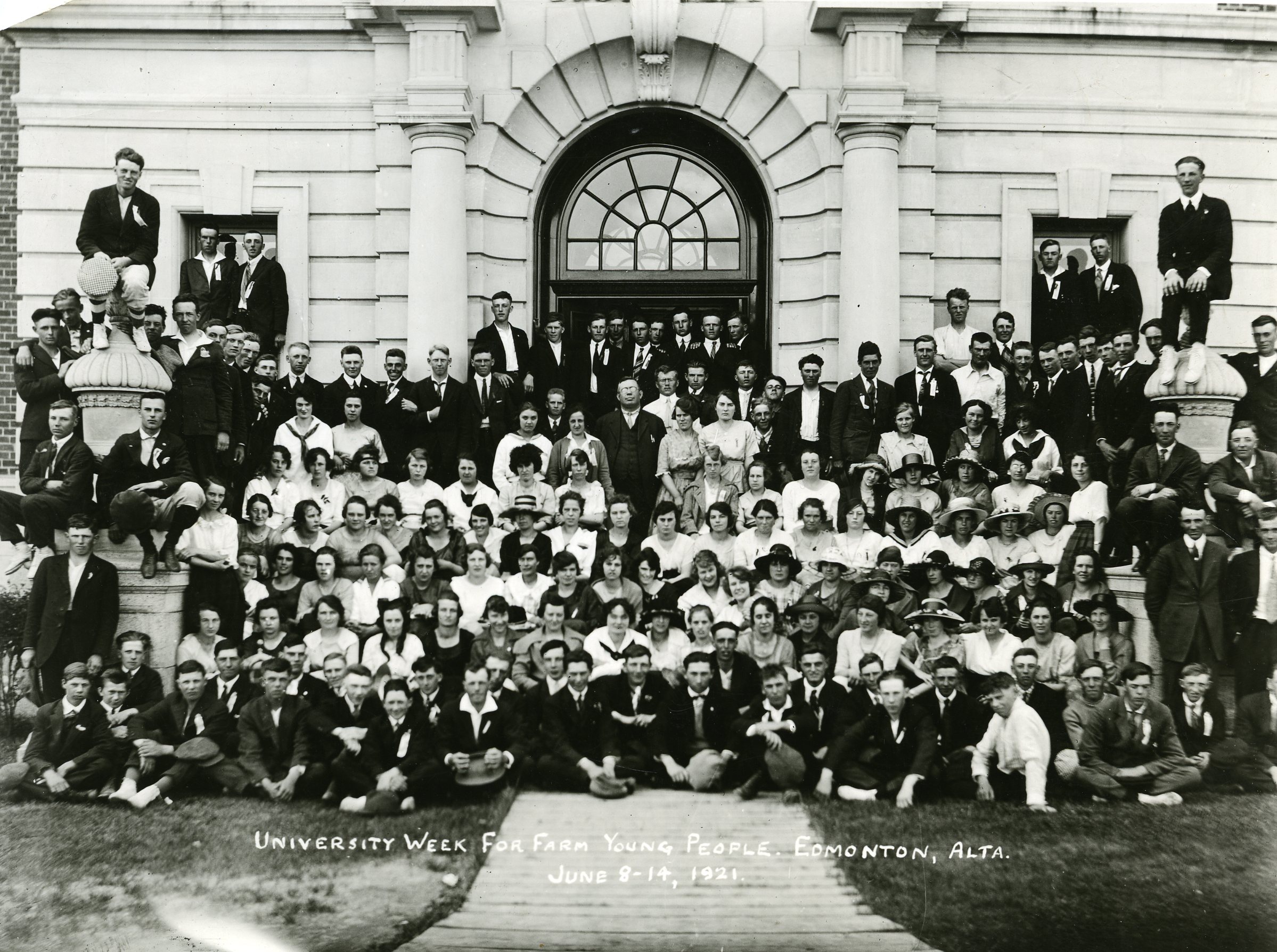

In 1918, United Farm Women of Alberta (U.F.W.A.) president, Irene Parlby, met with the acting president of the University of Alberta, Dean Kerr, to inquire as to how rural youth could gather and learn together on the University’s campus each summer, and the idea for Farm Young People’s Week was born. The first Farm Young People’s Week was held in June of 1919 and welcomed 150 rural ‘boys’ and ‘girls’ from across Alberta.
Originally referred to as University Week for Farm Young People, the yearly gathering welcomed youth to campus in June for an eight-to-ten-day schedule of programming offered by the University of Alberta’s Department of Extension. Later the Faculty of Agriculture and the School of Household Economics were collaborators in offering specific programming. The week offered rural youth the benefit of educational courses and social gathering as well as the opportunity to become acquainted with the University of Alberta and extended education opportunities.
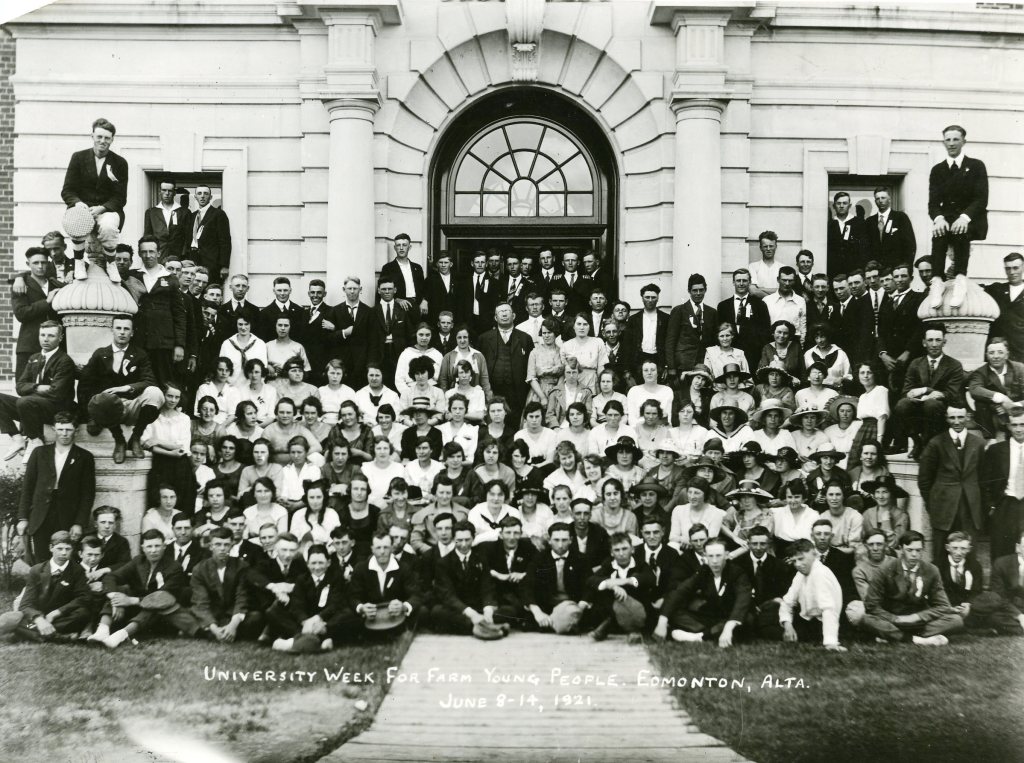
The opportunity to attend University Week was extended to all farm young people between the ages of 16 and 25 years, later extended to 27 years of age. Individuals from local youth-based groups were advised to attend as a representative ‘delegate’ of their organization, who could then share a report of their experience back to their Junior U.F.A. Local or group and inspire others to attend in future years. In early years, the majority of attendees were delegates of Junior U.F.A. Locals. The Annual Meeting of the Junior U.F.A. was hosted during the week, with officers providing their reports and undertaking officer elections and general business of the Junior U.F.A. Other members could attend at their own expense but could not vote on Junior U.F.A. business matters, unless the conference decided to grant them the privilege.
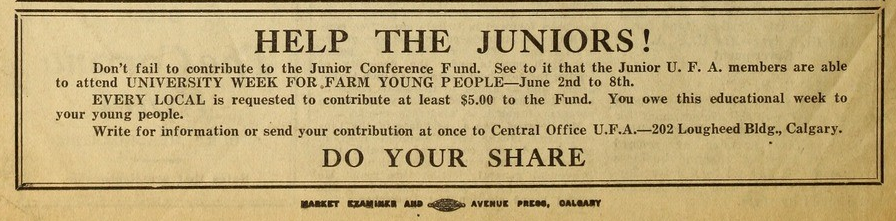
Requests were made to all Junior, U. F. W. A., and U. F. A. Locals to contribute to the “Junior Conference Fund.” The fund served to assist delegates in their ability to attend the week, originally primarily supporting transportation costs.
Mrs. R. Clarke Fraser, Convenor of Young People’s Work, reported at the 1923 U.F.W.A. Annual Convention:
“It is absolutely impossible to estimate what ‘University Week’ means to the future of this Province. Can you conceive the benefit to rural Alberta of sending upwards of one hundred young people yearly for a week’s study in the surroundings of the Provincial University and under the guidance of Alberta’s most able leaders of young people? On account of the financial difficulties of the past few years, many of these young people have hardly been able to leave their own communities, but ‘University Week’ gives them not only the opportunity of a change of surroundings, which is in itself an advantage to young people at the impressionable age, but it also gives them the privilege of meeting other farm young people under circumstances which will influence their whole lives.”
to read more of Mrs. Fraser’s report, see The U.F.A. Vol. 2, no. 6 (Apr. 2, 1923) Page 10
In 1924, each Local was asked to contribute at least $5.00 towards the fund to assist the delegates with their railway fares, in order to encourage as many young people to attend as possible. In years when the fund did not raise enough to cover all delegates’ railway fares, their fare coverage was pro-rated among the attendees, providing approximately 80% fare coverage. As the Senior Committee on Junior Work wrote in their 1929 The U.F.A. request for support, “surely we can engage in no more worthy activity than that of furnishing our young people with an experience which cannot fail to give them a new vision of life and service.”
Attendees stayed on campus in university residences and ate their meals in the university’s cafeteria. The week’s program was divided based on a ‘four-fold plan’ with focus on education, vocation, recreation, and socializing, aiming to develop both the mind and body.
A typical day of Young People’s Week began at 6:45 am with a reveille wake up call and making one’s bed before going to breakfast (with bed-making inspections occurring each day before noon), followed by physical training exercises and morning recreation at 7 am, breakfast at 8 am and then a ‘Morning Thoughts’ talk on life and character at 9 am, to inspire the youth for their day ahead.
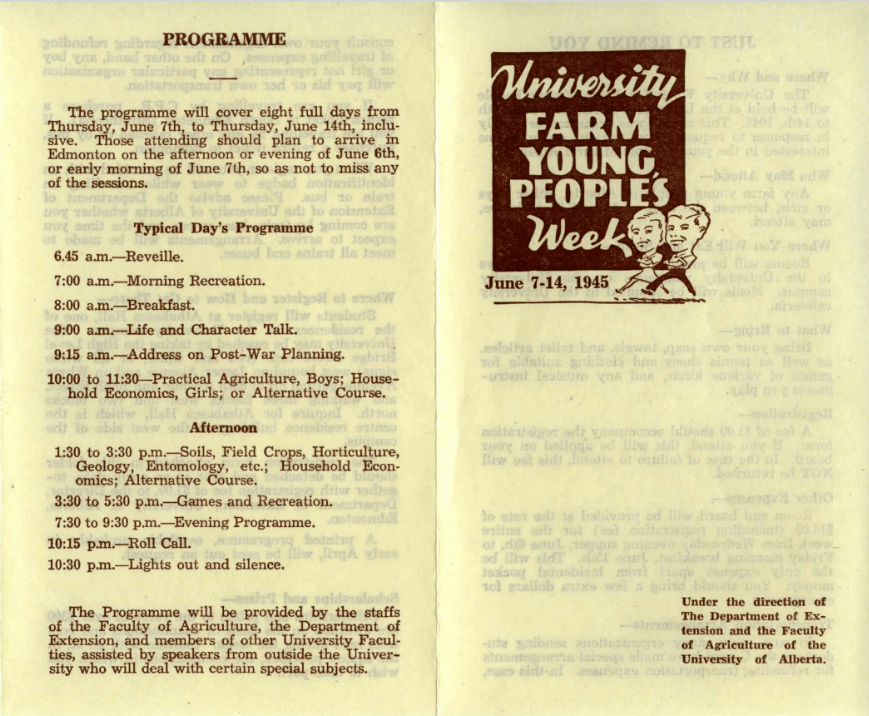
The day’s programming aimed to offer an engaging mixture of work and play. Practical agricultural teachings and demonstrations were offered, with focus on topics such as soils, cereal and forage crops, farm machinery and mechanics, grains and grasses, field husbandry, animal husbandry and veterinary science, entomology, geology, horticulture, dairy and poultry processes, application of engineering to agriculture, etc. Many courses were offered based on gender, with the bulk of specialized agricultural courses offered to boys, while the girls were provided with courses that focused on household economics, domestic science, cooking, sewing, home nursing and first aid, control of communicable diseases, bee-keeping, and other practical subjects. Attendees were also exposed to cultural lessons that included history and literature, demonstrating the breadth of learning opportunities available through the university. Tours were offered of university buildings, and demonstrations and explanations provided of the work of different laboratories and researchers, such as baking experiments to show the baking value of different samples of flour, or investigating wheat grown in different conditions to test for drought, frost, and disease resistance.
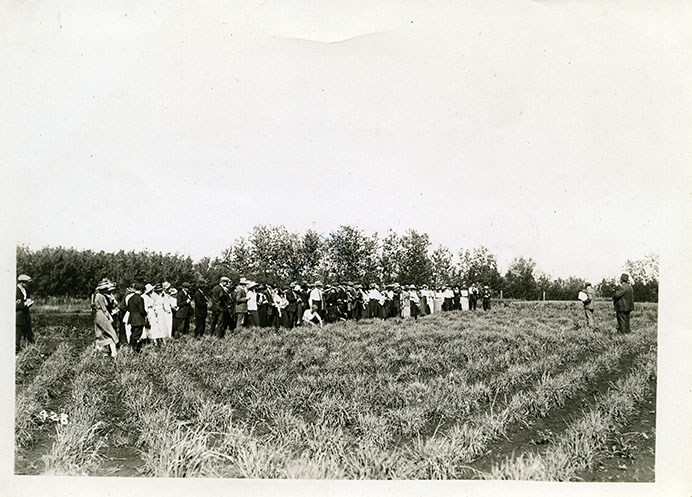
The day’s educational courses were followed by games and recreation in the late afternoon. An evening program was offered after dinner, which could include community singing, dancing, concerts, an organ recital, slideshows, educational films, theatre, public speaking, debate, or a ‘home-talent’ show that could include song recitations, piano, violin, ukulele, and magic acts. 10:15 pm was roll call and it was lights out by 10:30 pm. 
Course offerings evolved with the times, with certain courses being offered to both boys and girls that had previously only been offered to boys, and different subjects added, such as leadership in the rural community, community centres in rural areas, chairmanship and parliamentary procedure, democracy in theory and practice, co-operatives and credit unions, use of audio-visual equipment, farm record keeping, dramatics, stage-craft and make-up, photography, weaving, career opportunities, and academic planning. Greater alternative course offerings also grew out of necessity to support the continued learning of boys and girls who had attended a previous Farm Young People ‘s Week, were graduates of a School of Agriculture, or had attended a Dominion-Provincial Youth Training School.
In the 1960s, teaching staff for the week’s lectures included representation from the University of Alberta, Alberta Department of Agriculture, Alberta Wheat Pool, Farmers’ Union of Alberta, Farm Women’s Union of Alberta, United Grain Growers Limited, United Farmers of Alberta Co-operative, Alberta Co-operative Wholesale Association, and Credit Union League of Alberta.
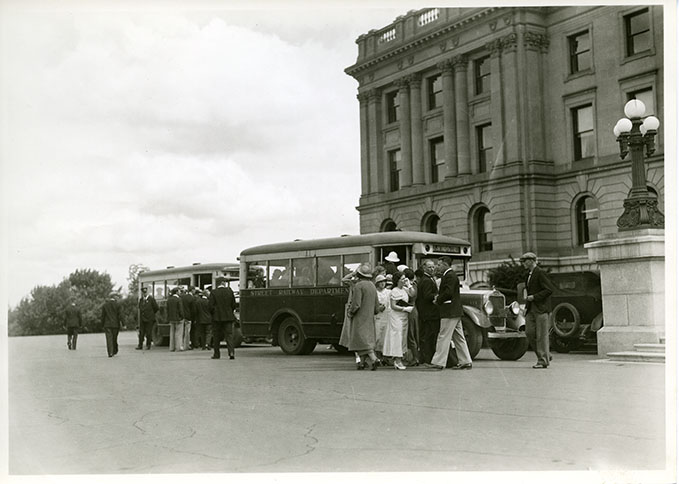
Organizers of the week also planned field trips and tours for the attendees to other locations in the city, over the years visiting locations such as the Great West Biscuit factory, a garment factory, a packing plant, Edmonton City Dairy, Oliver Tree Nursery, and Empire Theatre. Attendees were also given the opportunity to go on shopping tours, and visit Government House and the Legislature Buildings. In 1939, attendees were able to see the royal procession from a special stand when the King and Queen visited Edmonton during their week. Some of the boys were selected to transport war veterans and patients from the Provincial Special Hospital out on to the hospital lawn, for the King and Queen to pay them a visit.
Friendly competition, contests and prizes were a key highlight of University Week. A North vs. South sports day competition was usually held near the end of the week, with the teams vying for success as representatives of their part of the province and as the recipients of the coveted girls and boy sports cups. Over the years there was a public speaking contest sponsored by the U.F.A., with topics provided to attendees before the week, a grain judging contest sponsored by the Alberta Wheat Pool, weed identification contest sponsored by U.F.A. Central Co-operative Association, livestock judging contest sponsored by the Alberta Livestock Co-operative Association, and farmstead planning competition sponsored by the United Grain Growers Limited. A handicrafts competition was sponsored by the Edmonton Branch of the Canadian Handicrafts Guild, which would see quilts, leatherwork, basketry, needlework, and the occasional ironwork submitted for consideration. A household economics judging competition and home nursing competition were sponsored by the U.F.W.A.
Two scholarships were offered by the Provincial Department of Agriculture, one to a girl and one to a boy, good for one term at one of the Provincial Schools of Agriculture. The applicants had to complete a written examination during the latter part of the week based on the lectures and work completed during the week, as well as write a 2,000-word essay while on campus, focused on a previously circulated list of topics by the University’s Department of Extension. In select years, a reading course was offered to attendees in advance of the week, with those who completed the course receiving certificates. A general proficiency contest supported by United Grain Growers Limited was a two-part examination that focused on a verbal exam of general farming knowledge a farm young person would be expected to have, and a written exam based on learning from the week.
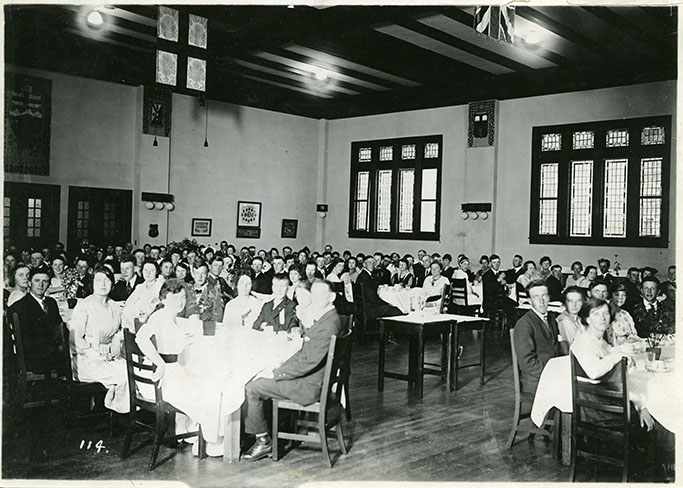
The week culminated in a banquet dinner and dance, where awards were presented and an orchestra would fill the hall with melodies that were met with square dancing, two-steps, fox trots, polkas, waltzes, Goldeye Lake shuffle, and in 1961, a new dance invented at that year’s Farm Young People’s Week called a “Ring-of-Fling.”
The week left a significant impact on those who attended, with many delegates returning to their Junior U.F.A. Locals eager to report on their learning, excited to deepen and foster the connections made with others from across the province, and the intent to raise funds to send more than one delegate from their group the following year.
Ruby Hayback wrote in her entry to the 1926 Junior Essay Contest, about Farm Young People’s Week:
“This week is really one opportunity in a life time for farm boys and girls. Its educational value in my opinion cannot be compared with any schooling a person can gain in the same length of time anywhere else. This is one of the most vital and far-reaching projects our Junior organization has undertaken.”
to read Ruby’s full essay, see The U.F.A. Vol. 6, no. 13 (May 2, 1927) Page 22
Farm Young People’s Week offered young people from across the province the opportunity to engage with the University in a way that could inspire and shape their future careers, with many attendees returning to their communities brimming with enthusiasm for the things they saw and learned at the University, and keen to engage in future learning through degree or extension courses.
1968 marked the 50th annual Farm Young People’s Week and is the last mention of the week in the UFHS archives. In 1933, it was estimated 2,250 young people had passed through the week from its inception. By 1942, the estimation was at over 4,000. With variable attendance of 75 to 150 youth each year, over 6,500 youth could have attended Farm Young People’s Week over the course of the fifty years it was offered.
Farm Young People’s Week undeniably fulfilled its founding mission of bringing rural youth together to gather and learn on the University’s campus, sparking lasting ripple effects for the attendees and the communities they have served, uplifted, and inspired over multiple generations.
Written by Jessica Z., Athabasca University student
References
Cameron, D. (1935). The History of Farm Young People’s Week at the University of Alberta. University of Alberta Archives. Department of Extension Directors’ Files, 1913-51, Acc. No. 74-23, Box 1, File 14.
Cunningham, E. (1926). The Advantages of University Week for Farm Young People. The U.F.A., 5(28), 7. https://ufhsarchives.andornot.net/permalink/theufav5n28ufoa-7.
Department of Extension and Faculty of Agriculture of the University of Alberta. (1945). University Farm Young People’s Week June 7 – 14, 1945. https://ufhsarchives.andornot.net/permalink/descriptions8502.
Department of Extension. (1947). 29th Annual Farm Young People’s Week June 5 to 12, 1947. https://ufhsarchives.andornot.net/permalink/descriptions8502.
Flach, D.M. (1939). Farm Young People’s Week Celebrates Its “Coming of Age.” The Western Farm Leader, 4(12), 3. https://archive.org/details/WFL_1939061601.
Fraser, H. (1924). The Young People’s Conference. The U.F.A., 3(29), 5. https://ufhsarchives.andornot.net/permalink/theufav3n29ufoa-5.
Haybak, R. (1927). The Advantages of University Week. The U.F.A., 6(13), 22-24. https://ufhsarchives.andornot.net/permalink/theufav6n13ufoa-22.
Hughes, F.A. (1933). The Farm Young People’s Conference. The U.F.A., 12(7), 20-21. https://archive.org/details/UFA_1933070301.
Hull, E. (1929). University Week and the Junior Conference. The U.F.A., 8(11), 28. https://ufhsarchives.andornot.net/permalink/theufav8n11ufoa-28.
Junior Branch of the United Farmers of Alberta. (1945). Report of the Twenty-Seventh Farm Young People’s Week Edmonton, June 7 – 14, 1945. https://ufhsarchives.andornot.net/permalink/descriptions8502.
Kidd, J.B. (1923). Farm Boys and Girls Spend Eventful Week at the University. The U.F.A., 2(11), 8. https://ufhsarchives.andornot.net/permalink/theufav2n11ufoa-16.
Meyer, A.M. (1922). The Young People’s Conference. The U.F.A., 1(8), 14. https://ufhsarchives.andornot.net/permalink/theufav1n8ufoa-14.
Senior Committee on Junior Work. (1929). Plans for the Forthcoming University Week for Farm Young People. The U.F.A., 8(11), 5. https://ufhsarchives.andornot.net/permalink/theufav8n11ufoa-5.
United Farmers of Alberta. (1923). The U.F.W.A. and Juniors. The U.F.A., 2(6), 10. https://ufhsarchives.andornot.net/permalink/theufav2n6ufoa-10.
United Farmers of Alberta. (1924). Will Your District Be Represented at the Young Peoples Conference? The U.F.A., 2(6), 8. https://ufhsarchives.andornot.net/permalink/theufav3n15ufoa-8.
United Farmers of Alberta. (1926). Help the Juniors! The U.F.A., 5(11), 16. https://ufhsarchives.andornot.net/permalink/theufav5n11ufoa-16.
United Farmers of Alberta. (1965). Farm Young People’s Week. The U.F.A. Co-operator, 3(7), 2. https://ufhsarchives.andornot.net/permalink/cooperator3_7-3.
United Farmers of Alberta. (1968). Farm Young People’s Week University of Alberta. The United Farmer, 6(6), 10. https://ufhsarchives.andornot.net/permalink/unitedfarmer6_6-12.
United Grain Growers, Ltd. (1942). Neighborly News from the Neighborly Elevator. https://ufhsarchives.andornot.net/permalink/descriptions11246.
University of Alberta Department of Extension. (1961). 1961 Farm Young People’s Week June 13 – 22, 1961 Application Form. https://ufhsarchives.andornot.net/permalink/descriptions11278.
University of Alberta. (1948). 30th Annual Farm Young People’s Week. https://ufhsarchives.andornot.net/permalink/descriptions8502.
University of Alberta. (1961). 43rd Annual Farm Young People’s Week. https://ufhsarchives.andornot.net/permalink/descriptions11278.


Very interesting, thanks so much for this detailed history!
LikeLike