
Overview
Founded in 1919, the United Farmers of Alberta Junior Branch (Junior U.F.A.) strove to support, encourage, and educate young farmers in agricultural policies and diplomacy. Through the senior U.F.A.’s supervision, the Junior U.F.A ensured members engaged in proper democratically structured meetings. These meetings trained the youth in public speaking and articulating their opinions on agricultural topics that directly affected their communities futures. In tandem with their meetings, the Junior U.F.A. were also heavily looked to for social events and community bonding. Although the Junior U.F.A. transitioned to the Junior Farmers Union of Alberta in 1949, the organization maintained their general duties in aiding the community and were the founders behind the Goldeye Centre.

(UF 2003.0144.38).
Origins
Before 1919, Irene Parlby, a historic member and president of the United Farm Women of Alberta (U.F.W.A.), wrote a persuasive letter concerning the need for involving rural youth in decision making and parliamentary debates. Parlby advocated strongly for the formation of multiple clubs tailored for youth and argued: “the farmers’ movement will never reach its full success until we have a large body of trained leaders. These leaders must be trained while still young; they must imbibe with their growth the great principles for which we stand.” (See UF 2002.0033.01 for the full digitized letter).
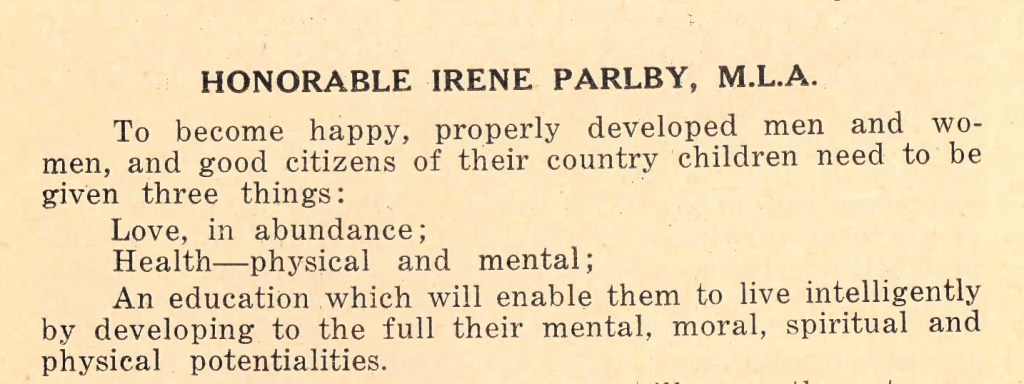
(UF 2002.0033.08).
Parlby suggests that the rural youth are merely attaining one-sided educational development and urged that these youth’s lives should be nurtured through education, vocational, economic, and social development. Moreover, Parlby explains that the clubs, if formed, should follow U.F.A’s meeting procedures and Constitution. These meetings, as Parlby envisioned in her letter, would be administered by an adult UFA representative; however, administrative duties such as officer appointments and meeting procedures were to be conducted by the members of the Junior U.F.A. From this, Parlby offers that after a sufficient amount of Junior U.F.A. clubs are created, U.F.A. may have an opportunity to hire an important worker from the Young Women’s Christian Association (Y.W.C.A.) who can provide extra guidance on training youthful leaders and reorienting meetings to meet a higher standard of education. In concluding her letter, Parlby is clear in her goals by stating she and U.F.A. “want[s] to see every boy and girl of ‘teen age in the rural districts enrolled as a junior member of the organization during that time, then we can begin to talk. Are you going to help?”
In 1919, 20 Junior UFA locals were organized including for Consort and Okotoks, and reached a membership of 1,000 teenagers by 1925. Local chapters were located mainly in farming towns around Alberta. The Junior U.F.A. provided updates to the wider U.F.A. membership in “The U.F.A.” publication. In addition, a delegate from each Junior local was invited to the Annual UFA Convention, and the Junior president had a place on the UFA Board of Directors.

(UF 2003.0111.05).

(29-63).
As pictured above from archival records, some past Jr. UFA members had long careers with the UFA, including Wilf Hoppins who became the UFA’s general manager from 1951 to 1963, and Lawrence Proudfoot who became Manager of UFA’s Petroleum Division from 1964 to 1987.
Junior U.F.A. Education

According to Canadian historian Bradford James Rennie:
“Farmers used various types of formal and informal education, including that supported by corporations and the state, for these purposes. Farmers’ commitment to self-education reflected a European and North American popular tradition. Since the early nineteenth century, non-elites had studied their economic and political difficulties and sought solutions in farm, co-operative, socialist, labour, and church organizations. This practice and the rise of mass education fostered a widely held belief in learning for self-improvement.”
This form of farming education weaved its way into the Junior U.F.A.’s meetings. Although Irene Parlby organized the establishment of the Junior U.F.A., it was U.F.W.A. President Susan Gunn who became the first young people’s convenor. With the funds provided by the U.W.F.A. After the official establishment of the Junior U.F.A., meetings were immediately placed into action. According to the archival record Minutes Junior U.F.A. Board Meetings and Business Sessions: 1920 to 1938, the general structure is revealed of how meetings were conducted.


As these records show, the Junior U.F.A. Minutes (on the left) are structured in a similar manner to the U.F.W.A.’s standard Minutes (on the right). This is because the Junior U.F.A. was under supervision of a senior U.F.W.A. member who oversaw the proceedings of these meetings. The Junior U.F.A. Minutes contain a sense of youthful expression while mirroring the appropriate format as standardized by the U.F.A. and U.F.W.A. Junior U.F.A. meetings were usually conducted at the University of Alberta rather than at hotels or town halls.
Activities and Outline of Duties
The Junior U.F.A.’s importance as a branch of the U.F.A. was much more than education for youth. During its prime, the Junior U.F.A. was the head of annual business sessions which were held during Farm Young People’s Week.

(UF 2002.0033.10).
The Junior U.F.A. and its young representatives were fully in control of how the day’s business meetings and activities were run. Much to the elation of many U.F.A. seniors, it has been reported that the youth performed exceptionally in their leadership roles; especially in how resolutions were debated. According to documented records, some resolutions covered: Farmers Creditors, Minority Groups, Youth Rehabilitation, Fuel Oil Tax, Price of Wheat, and Dominion Agricultural Policy. However, the Junior U.F.A. not only conducted important matters behind closed doors. Many communities relied and looked towards the Junior U.F.A. for social connection and quality of life. For instance, the Junior Branch would be in charge of organizing events such as plays, dances, debates and ball games.

(UF 2002.0033.07).

(The U.F.A. Feb. 15 1930, Page 28).
While this may seem less than usual for a well-established and distinguished branch of intelligent youth, being able to play well together was equally important as learning to work together as a team.
The 1949 Split
In 1949, the U.F.A. split into separate factions – one for retail marketing (United Farmers of Alberta Co-operative) and one for education and advocacy purposes (Farmers’ Union of Alberta). In a statement issued by the Farm Women’s Union of Alberta (F.W.U.A.), they proclaimed that they continuously devote time to helping their junior faction. As such, Mrs. Taylor and Mrs. Armstrong was elected that same year as executive members of the Junior Farmer’s Union of Alberta (F.U.A.). Much of the Junior F.U.A.’s activities stayed relatively the same such as the continuation of Farm Young People’s Week and consistent Junior Executive board meetings. In addition to these events, Mrs. Taylor helped to select a Stampede Queen Candidate while Mrs. Armstrong worked closely with Associated Canadian Travelers and took care of the general income the Junior F.U.A. would receive.
Creation of Goldeye

(The United Farmer 1981 January-February Page 13).
The Junior F.U.A. would branch out further into aiding agricultural communities with educational opportunities by establishing Goldeye Centre near Nordegg. Created by the executive members of the Junior F.U.A., who were inspired by a leadership camp they attended in Montana in 1957, the U.F.A. endorsed their ideas which encompassed a youth summer camp which continues to serve the community to this day. This summer camp’s primary goal is to give kids opportunities to make new friends while also learning valuable life skills. After opening its doors to the public in 1958, Goldeye Centre’s success was attributed to the numerous youth who sought summer jobs and the numerous leadership staff funded by: Women of Unifarm, Federal Co-ops Ltd., Alberta Wheat Pool, United Grain Growers, United Farmers of Alberta Co-operative, the Department of Agriculture, Calgary Co-op, Credit Union Central, and Co-operative Insurance Services. Today, Goldeye Centre has expanded its services for both youths and adults with continued summer camps and additional work retreats.
Conclusion
With the rise and advocacy for youthful voices within the agricultural space, the Junior U.F.A. became renowned for their group of brilliant young minds who brought unique perspectives and support to farming communities. Spearheaded by Irene Parlby and other members of the United Farm Women of Alberta, the foundations of the Junior U.F.A. gave educational opportunities to young farmers who were seen as important members of the agricultural community and whose voices were paramount to the future of farming. Although the Junior U.F.A. organized in professional settings such as in Universities and carried out similar meetings to U.F.A., their services to the public were considered pivotal to maintaining their communities livelihoods and sociability. As such, the Junior U.F.A., in their most active era, were involved in a plethora of community activities such as ball games and debates; both which contributed to fostering and maintaining a tight knit farming community. Furthermore, and even after the dissolution of Junior U.F.A., the Junior F.U.A. continued their contributions towards the agricultural community even further by creating the Goldeye Centre. Through the Junior U.F.A.’s historical efforts in education and societal betterment, their legacy in the agricultural community continues to stand strong and united.
Written by Jasmine Newman, Mount Royal University practicum student
References
“A Brief Outline of The Junior Branch of The United Farmers of Alberta.” Fonds 3, Series 1, File 6. In custody of the United Farmer’s Historical Society. Retrieved from https://ufhsarchives.andornot.net/permalink/descriptions1287.
“Bill McCartney & Lorne Proudfoot.” Fonds 11 Series 16, File 3. In custody of the United Farmer’s Historical Society. Retrieved from https://ufhsarchives.andornot.net/permalink/descriptions6439.
Jaques, Carrol L. Unifarm: A Story of Conflict & Change. Vol. 6. University of Calgary Press, 2001.
“Junior Branch.” Fonds 3, Series 1, File 5. In custody of the United Farmer’s Historical Society. Retrieved from https://ufhsarchives.andornot.net/permalink/descriptions1285.
“Junior UFA Group Photo.” Fonds 11 Series 9, File 2. In custody of the United Farmer’s Historical Society. Retrieved from https://ufhsarchives.andornot.net/permalink/descriptions5966.
Langford, Nanci L. Politics, Pitchforks, and Pickle Jars: 75 Years of Organized Farm Women in Alberta. Calgary: Detselig Enterprises, 1997.
“Minutes Junior U.F.A. Board Meetings and Business Sessions.” Fonds 3, Series 2, File 1. In custody of the United Farmer’s Historical Society. Retrieved from https://ufhsarchives.andornot.net/permalink/descriptions10212.
“Neighborly News From the Neighborly Elevator.” Fonds 3, Series 1, File 5. In custody of the United Farmer’s Historical Society. Retrieved from https://ufhsarchives.andornot.net/permalink/descriptions11246.
“Newspaper Clippings.” Fonds 3, Series 1, File 5. In custody of the United Farmer’s Historical Society. Retrieved from https://ufhsarchives.andornot.net/permalink/descriptions7145.
“Official Minutes U.F.W.A. Executive, Board & Convention 1934 1937 Page 10.” United Farm Women of Alberta. In custody of the United Farmer’s Historical Society. Retrieved from https://ufhsarchives.andornot.net/permalink/theufwa2119ufoa-10.
Rennie, Bradford James. The Rise of Agrarian Democracy: The United Farmers and Farm Women of Alberta, 1909-1921. Toronto: University of Toronto Press, 2017. https://doi.org/10.3138/9781442682207.
“The Junior U.F.A.” Fonds 3 Series 1, File 5. In custody of the United Farmer’s Historical Society. Retrieved from https://ufhsarchives.andornot.net/permalink/descriptions11245.
“The U.F.A. Vol. 9, no. 4 (Feb. 15 1930) Page 28.” The U.F.A. Newspaper. In custody of the United Farmer’s Historical Society. Retrieved from https://ufhsarchives.andornot.net/permalink/theufav9n4ufoa-28.
“The United Farmer 1981 January-February Page 13.” The United Farmer. In custody of the United Farmer’s Historical Society. Retrieved from https://ufhsarchives.andornot.net/permalink/unitedfarmer19_1-13.
“The United Farm Women of Alberta (Junior Clubs).” Fonds 3, Series 1, File 1. In custody of the United Farmer’s Historical Society. Retrieved from https://ufhsarchives.andornot.net/permalink/descriptions1279.
“Training for Leadership.” Fonds 3, Series 1, File 4. In custody of the United Farmer’s Historical Society. Retrieved from https://ufhsarchives.andornot.net/permalink/descriptions1284.
“Wilfred Hoppins.” Fonds 11 Series 15, File 10. In custody of the United Farmer’s Historical Society. Retrieved from https://ufhsarchives.andornot.net/permalink/descriptions3441.
Further Readings
Langford, Nanci. “United Farm Women of Alberta.” The Canadian Encyclopedia. Historica Canada. Article published October 10, 2006; Last Edited January 07, 2022. https://www.thecanadianencyclopedia.ca/en/article/united-farm-women-of-alberta
Reimer, Paige. “Goldeye Centre Seeks Support for Future.” Alberta Farmer Express. Glacier Farm Media. Article published September 22, 2022. https://www.albertafarmexpress.ca/news/goldeye-centre-seeks-support-for-future/.


Well done Jasmine.
LikeLike
Nice to see more info on the Jr UFA!
LikeLike